Advance Tax 15 December 2026: Essential Guide to Avoid Costly Interest
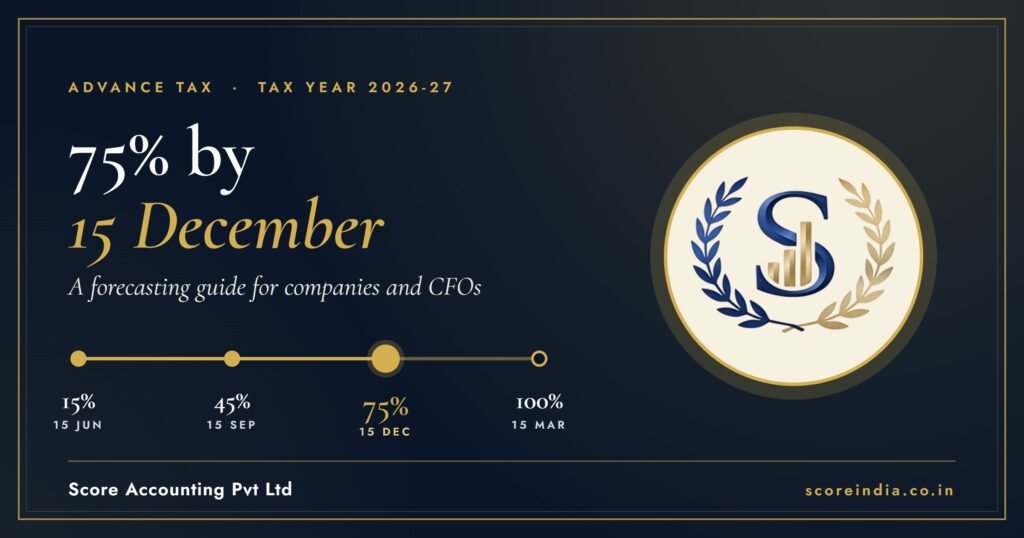
The advance tax 15 December 2026 instalment is the third of four for Tax Year 2026-27. By that date, most companies must have paid at least 75% of the advance tax they expect to owe for the year. The catch is that the year still has three and a half months to run. So the December instalment is not really a tax deadline. It is a forecast, and the quality of that forecast decides whether the company pays interest, locks up cash it needs, or gets it right.
Last updated: 10 November 2026. Applies to Tax Year 2026-27 (1 April 2026 to 31 March 2027) under the Income-tax Act, 2025.
What is advance tax? Advance tax is income tax paid during the year in which the income is earned, in instalments, instead of in one amount after the year ends. Companies pay it on their estimated profit for the full year, after taking credit for TDS and TCS.
This guide explains what the law asks for under the Income-tax Act, 2025, what a wrong estimate costs, and the forecasting checks a finance team should run in the five weeks before 15 December.
Quick answer
- Advance tax is paid in four cumulative instalments: 15% by 15 June, 45% by 15 September, 75% by 15 December and 100% by 15 March (section 408).
- It applies when the estimated tax for the year, after TDS and TCS, is ₹10,000 or more.
- Pay too little by 15 December and interest is charged on the shortfall under section 425. If total advance tax ends up below 90% of the assessed tax, further interest applies under section 424.
- Pay too much and the excess stays with the department until it is refunded after the return is processed.
- For Tax Year 2026-27, pay on the e-Pay Tax portal under the Income-tax Act, 2025, Tax Year 2026-27, type of payment Advance Tax (100).
- The fix is a proper full-year forecast before you pay, not last year’s number with a percentage added.
Advance tax 15 December 2026: the rule under the Income-tax Act, 2025
From 1 April 2026, advance tax is governed by sections 403 to 409 of the Income-tax Act, 2025. The dates and percentages have not changed from the old law. The Income Tax Department’s own transition FAQs confirm that the quarterly instalment dates and amounts remain the same.
| Due date | Cumulative advance tax to be paid |
|---|---|
| On or before 15 June 2026 | At least 15% |
| On or before 15 September 2026 | At least 45% |
| On or before 15 December 2026 | At least 75% |
| On or before 15 March 2027 | 100% |
The percentages are cumulative. The December test is whether everything paid so far adds up to 75% of the tax you now estimate for the full year. If your estimate has gone up since September, the December payment has to absorb the whole increase.
Old and new section numbers
Most finance teams still think in the old section numbers. This table maps them to the Income-tax Act, 2025.
| What it covers | Income-tax Act, 1961 | Income-tax Act, 2025 |
|---|---|---|
| Advance tax: liability, computation and payment | Sections 207 to 219 | Sections 403 to 409 |
| Instalments and due dates | Section 211 | Section 408 |
| Interest for default in payment of advance tax | Section 234B | Section 424 |
| Interest for deferment of instalments | Section 234C | Section 425 |
| Interest for late return | Section 234A | Section 423 |
| Presumptive scheme for business and professions | Sections 44AD and 44ADA | Section 58(2), Table S. No. 1 and 3 |
Who pays in four instalments
Every person whose estimated tax for the year, after TDS and TCS, is ₹10,000 or more must pay advance tax. Taxpayers who declare income under the presumptive scheme in section 58(2) (Table S. No. 1 or 3, the old sections 44AD and 44ADA) can pay the whole amount in one instalment by 15 March instead. That option is not available to companies, so for a company the four-instalment schedule applies.
Any amount paid by 31 March is still treated as advance tax for that financial year, but paying it late does not stop interest for the earlier instalments.
What a wrong estimate costs
Guess low: interest on the shortfall
Section 425 charges simple interest of 1% a month on the shortfall for each instalment. For the 15 December instalment the charge is 3% of the shortfall, covering three months. The shortfall is measured against the tax due on the income you finally declare in your return, not against your estimate at the time.
For the June and September instalments there is a small cushion: no interest is charged if at least 12% has been paid by 15 June and 36% by 15 September. There is no such cushion for December. The full 75% is the test.
On top of that, section 424 applies if the total advance tax paid for the year is less than 90% of the assessed tax. Interest then runs at 1% a month on the unpaid amount from 1 April after the tax year until the tax is paid or assessed.
Companies that are not on a concessional tax regime should also check minimum alternate tax on book profit at each instalment, and base advance tax on whichever is higher. The interest provisions apply in the same way when the liability is under MAT.
Guess high: cash locked away
Overpaying is not penalised, but it is not free either. The excess sits with the department until your return is processed and the refund is issued. For a growing business that needs working capital in the last quarter, that is cash it cannot use.
A worked example
Take a company that estimated its tax for Tax Year 2026-27, after TDS, at ₹40 lakh. It paid ₹6 lakh by 15 June and a further ₹12 lakh by 15 September, ₹18 lakh in total. For December it plans to bring the total to 75% of ₹40 lakh, which is ₹30 lakh, so it pays ₹12 lakh.
Now suppose a strong festive season and a one-off asset sale push the final tax on the returned income to ₹60 lakh.
| Amount | |
|---|---|
| 75% of the actual tax of ₹60 lakh | ₹45 lakh |
| Paid by 15 December | ₹30 lakh |
| Shortfall | ₹15 lakh |
| Interest under section 425 at 3% | ₹45,000 |
That ₹45,000 is for the December instalment alone. The June and September instalments are also tested against the final tax, so they may attract interest as well. All of it could have been avoided with a better forecast in November. The figures are illustrative, and section 425 has some exceptions, explained below.
Why this is a forecasting problem
Most finance teams close their books monthly. That tells them what has happened. Advance tax asks a different question: what will the full year look like? Answering it needs five things.
- First-half actuals that are actually closed. The April to September numbers should be reconciled, with provisions, depreciation and accruals in place, not taken straight from a trial balance.
- A realistic second-half forecast. Many businesses earn unevenly through the year. A festive-season peak, a large year-end order or a slow quarter changes the full-year profit. Last year’s profit plus 10% is not a forecast.
- One-offs flagged early. Asset sales, investment exits, large bonuses, write-offs and settlements can move the tax figure sharply. Each one should be identified before the December payment, not discovered at year end.
- Credits counted correctly. Advance tax is payable on the estimate after TDS and TCS, so the expected credits for the year need to be tracked against Form 26AS and the annual information statement.
- A cash plan. The December payment has to fit around the month’s other outflows: salaries, TDS deposits and GST. A large advance tax cheque that surprises the treasury creates its own problem.
You can revise your estimate at any instalment without filing anything with the department. You simply pay the corrected amount by the next due date.
The exceptions worth knowing
Section 425 does not charge interest on a shortfall caused by under-estimating or not estimating certain incomes, as long as the tax on them is paid in the remaining instalments or by 31 March. These include capital gains, dividend income and business income arising for the first time. This helps with an unexpected asset sale, but it is not a reason to skip the forecast for regular trading profit.
How to pay advance tax for Tax Year 2026-27
The e-Pay Tax service on the income tax portal now offers two Acts. Payments for Tax Year 2026-27 onwards must be made under the Income-tax Act, 2025. The Income-tax Act, 1961 option is only for Assessment Year 2026-27 and earlier, such as self-assessment tax for last year. Choosing the wrong Act or year books the payment to the wrong period, which then has to be corrected.
- Log in to the e-Filing portal and go to e-File → e-Pay Tax.
- Select Income Tax Act, 2025 and click New Payment.
- Choose the Income Tax tile and select Tax Year 2026-27.
- Select the type of payment as Advance Tax (100). The challan for the new Act is ITNS 280N.
- Enter the amount, choose the payment mode and pay. Download the challan and keep it with your advance tax working.
Do not leave the payment to the evening of 15 December. Bank and portal delays on the last day are common.
A five-week checklist before the 15 December 2026 advance tax date
- Close and review the April to September books, including provisions and depreciation.
- Build a month-by-month forecast for October to March, with the assumptions written down.
- List known and likely one-offs and estimate their tax effect.
- Reconcile expected TDS and TCS credits with Form 26AS and the AIS.
- Work out the cumulative 75% figure, subtract what has already been paid, and fix the December amount.
- Agree the payment date with the treasury so it does not clash with other December outflows. Our compliance calendar lists the month’s other due dates.
- Record the working, so the March instalment starts from a documented base.
Where a Virtual CFO fits
Most growing businesses do not need a full-time CFO to get this right. They need CFO-level thinking at moments like this one: a forecast that holds up, a view of the one-offs, and a cash plan the treasury can act on. That is what a Virtual CFO brings, without the cost of a full-time hire. If you are weighing the two options, our comparison of a Virtual CFO and a full-time CFO sets out the cost and scope.
Score’s Virtual CFO practice works with finance teams on forecasting, MIS and tax planning through the year, so the December instalment is a decision rather than a guess. To review your estimate before the advance tax 15 December 2026 instalment, get in touch with our team.
Frequently asked questions
When is the third advance tax instalment due for Tax Year 2026-27?
On or before 15 December 2026. By then, total advance tax paid should be at least 75% of the estimated tax for the year.
Does the Income-tax Act, 2025 change the advance tax dates?
No. The dates and percentages are the same as under the 1961 Act. The provisions are now in sections 403 to 409, and the year is called the tax year instead of the assessment year.
What is the interest if the December instalment falls short?
Under section 425, simple interest of 3% is charged on the shortfall against 75% of the tax due on the returned income. Separate interest under section 424 can apply if total advance tax is below 90% of the assessed tax.
Can a company pay all its advance tax by 15 March?
No. The single-instalment option by 15 March is only for taxpayers under the presumptive scheme in section 58(2), which companies cannot use.
Is there any interest cushion for the December instalment?
No. The 12% and 36% cushions apply only to the June and September instalments. By 15 December the full 75% must be paid to avoid interest.
Which Act should I select on the e-Pay Tax portal for advance tax?
For Tax Year 2026-27 (FY 2026-27), select the Income-tax Act, 2025, Tax Year 2026-27 and Advance Tax (100). The 1961 Act option is for Assessment Year 2026-27 and earlier.
Does a company under MAT have to pay advance tax?
Yes. A company liable to minimum alternate tax pays advance tax on that liability, and interest for short payment applies in the same way.
Can we change our estimate after paying the September instalment?
Yes. You can revise the estimate at any time and adjust the next instalment. No intimation needs to be filed with the department.
Sources
This article reflects the law as of 10 November 2026. It is general information, not advice for a specific case. Check the latest provisions or speak to an adviser before paying.
- Income-tax Act, 2025, section 408 (instalments of advance tax and due dates): incometaxindia.gov.in
- Income-tax Act, 2025, section 425 (interest for deferment of advance tax): incometaxindia.gov.in
- Income Tax Department, FAQs on advance tax: incometaxindia.gov.in
- Income Tax Department, FAQs on the transition to the Income-tax Act, 2025: incometaxindia.gov.in
- e-Filing portal, general questions on tax payments under the two Acts: incometax.gov.in
- Income Tax Department, FAQs on interest under sections 423 to 426: incometaxindia.gov.in
Related service: Score Accounting Pvt Ltd offers tax and GST advisory services covering GST, direct tax and transfer pricing.
Disclaimer: This article is for general information only and does not constitute legal, financial or tax advice. Laws, rates and due dates change, and their application depends on your facts. Please consult a qualified professional before acting on it.