Financial Year-End Checklist 2026-27: 7 Critical Deadlines Before 31 March
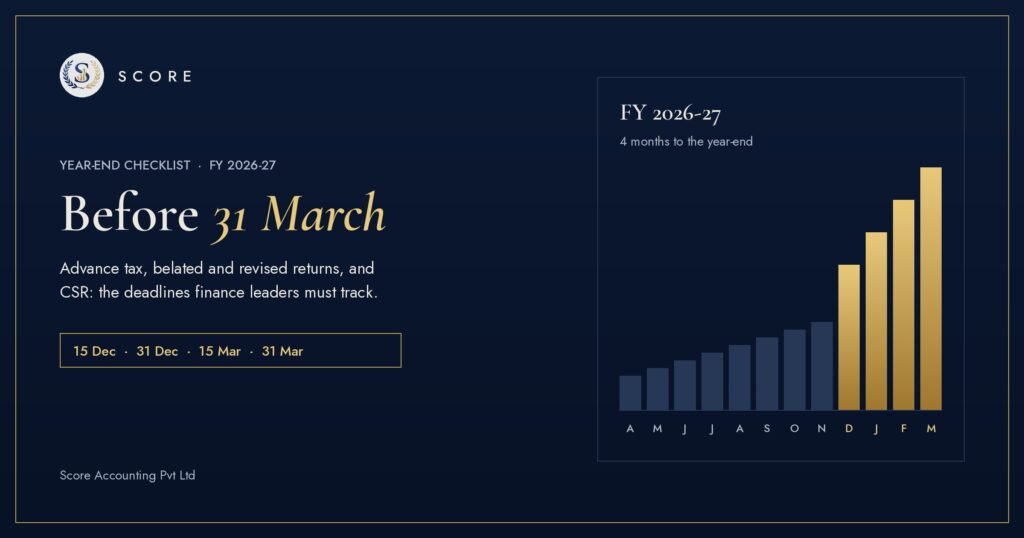
The calendar year is ending, but India’s financial year is not. Tax Year 2026-27 runs until 31 March 2027, and the next four months decide whether your year-end close is calm or rushed. This financial year-end checklist sets out every deadline finance leaders should track between now and 31 March 2027, what each one requires, and how to plan the quarter so nothing is left for the last week.
This year has one more complication. Tax Year 2026-27 is the first year under the Income-tax Act, 2025, while returns for FY 2025-26 are still governed by the Income-tax Act, 1961. Most finance teams will be working under both Acts at the same time until March.
Financial year-end checklist at a glance
| Date | What is due | Law |
|---|---|---|
| 15 December 2026 | Third advance tax instalment: at least 75% of the year’s estimated advance tax | Section 408, Income-tax Act, 2025 |
| 31 December 2026 | Last date for belated returns for FY 2025-26 (AY 2026-27) | Section 139(4), Income-tax Act, 1961 |
| 15 March 2027 | Final advance tax instalment: 100% of the year’s estimated advance tax | Section 408, Income-tax Act, 2025 |
| 31 March 2027 | Last date for revised returns for FY 2025-26; a fee applies after 31 December 2026 | Sections 139(5) and 234-I, Income-tax Act, 1961 |
| 31 March 2027 | Financial year ends: CSR obligation for the year should be spent | Section 135, Companies Act, 2013 |
| 30 April 2027 | Unspent CSR on ongoing projects moved to an Unspent CSR Account | Section 135(6), Companies Act, 2013 |
| 30 September 2027 | Other unspent CSR transferred to a Schedule VII fund | Section 135(5), Companies Act, 2013 |
Advance tax: 15 December and 15 March
Under section 408 of the Income-tax Act, 2025, advance tax is paid in four cumulative instalments. By 15 December 2026, at least 75% of the advance tax for the year should have been paid, after adjusting the June and September instalments. By 15 March 2027, the full amount should be paid.
- The December figure is a forecast, not a final number. It depends on an honest estimate of profit for the full year, including the quarter that has not happened yet.
- Taxpayers who declare income under the presumptive scheme do not use the four instalments. They pay the whole of their advance tax in one payment by 15 March.
- Any advance tax paid by 31 March still counts as advance tax for the year. But a shortfall at an instalment date can attract interest under section 425 for that period.
- When paying, select the Income-tax Act, 2025 and Tax Year 2026-27 on the challan. Payments for FY 2025-26 or earlier stay under the 1961 Act.
For a worked example of how the December instalment and interest are calculated, read our guide to advance tax on 15 December 2026.
Belated and revised returns for FY 2025-26
On any financial year-end checklist, two different deadlines apply to last year’s income tax returns, and they are easy to confuse.
Belated returns: 31 December 2026
If a return for FY 2025-26 (AY 2026-27) was not filed by its original due date, it can still be filed as a belated return. The Income Tax Department confirms the last date is 31 December 2026, or before the assessment is completed, whichever is earlier. This deadline has not changed.
Revised returns: now 31 March 2027
A revised return corrects a mistake or omission in a return already filed. Budget 2026 extended this window. For AY 2026-27, a revised return can be filed until 31 March 2027, or before the assessment is completed, whichever is earlier.
The extra time is not free. Under section 234-I, a revised return filed in the extended window, for AY 2026-27 between 1 January and 31 March 2027, attracts a fee of ₹1,000 if total income does not exceed ₹5 lakh, and ₹5,000 in any other case. If you already know a return needs correcting, file the revision before 31 December 2026.
CSR: check the spend before 31 March
Companies covered by section 135 of the Companies Act, 2013 must spend their CSR obligation within the financial year. The time to review spending is now, not in the last week of March, because what happens to an unspent amount depends on the type of project.
- Ongoing projects: unspent money must be transferred within 30 days of the end of the financial year to a separate bank account called the Unspent Corporate Social Responsibility Account. For FY 2026-27, that is by 30 April 2027. The company then has three financial years from the transfer to spend it.
- Other unspent amounts: unless the amount relates to an ongoing project, it must be transferred to a fund specified in Schedule VII within six months of the end of the financial year, which is by 30 September 2027.
- Board report: if the company does not spend the full amount, the Board must give the reasons in its report.
- Penalties: a company in default faces a penalty of twice the amount required to be transferred or ₹1 crore, whichever is less. Every officer in default faces one-tenth of that amount or ₹2 lakh, whichever is less.
Adding a quarter-by-quarter review of CSR spend, project status and fund transfers to your financial year-end checklist avoids both the penalty and a rushed allocation in March.
A quarter plan for finance teams
Deadlines are only part of year-end. The quality of the close depends on work spread across the quarter. Here is a simple financial year-end checklist, month by month:
December
- Pay the third advance tax instalment by 15 December on an updated profit estimate.
- Check that every FY 2025-26 return has been filed, and file any corrections before 31 December to avoid the revision fee.
- Work through the rest of the month’s filings using our December 2026 compliance calendar.
January
- Reconcile bank, vendor and customer ledgers, and send balance confirmations.
- Review CSR project progress against the year’s budget.
February
- Verify fixed assets and inventory, and review provisions and contingent liabilities.
- Re-estimate the year’s profit for the final advance tax instalment.
- Decide which CSR projects will be classed as ongoing, and plan any transfers.
March
- Pay the final advance tax instalment by 15 March.
- Complete CSR spending for the year.
- Agree cut-off procedures and an audit timetable with your auditors.
Frequently asked questions
When does the financial year 2026-27 end?
Tax Year 2026-27, the financial year, ends on 31 March 2027. It is the first year governed by the Income-tax Act, 2025.
What is the last date to revise an income tax return for FY 2025-26?
31 March 2027, or before the assessment is completed, whichever is earlier. A revised return filed after 31 December 2026 attracts a fee of ₹1,000 if total income is up to ₹5 lakh, and ₹5,000 otherwise, under section 234-I.
Has the belated return deadline also moved to 31 March?
No. Budget 2026 extended only the revised return deadline. A belated return for FY 2025-26 must still be filed by 31 December 2026, or before the assessment is completed, whichever is earlier.
How much advance tax is due by 15 March 2027?
The full amount of advance tax for Tax Year 2026-27, less what has already been paid. Taxpayers under the presumptive scheme pay their whole advance tax in a single payment by 15 March.
What happens to unspent CSR money at the end of the financial year?
Unspent money relating to ongoing projects must be moved to an Unspent CSR Account within 30 days, by 30 April 2027 for FY 2026-27. Other unspent amounts must go to a Schedule VII fund within six months, by 30 September 2027.
How Score can help
Score Accounting Pvt Ltd works with companies on taxation, audit and CSR advisory, so the year-end close is planned as one piece of work rather than separate deadlines. If you would like a partner-led team to run your financial year-end checklist for you, our virtual CFO service covers it end to end. Speak to our team.
Official sources
Dates and rules in this financial year-end checklist are as published up to 24 November 2026. Always check the latest notifications before paying or filing.
- Income-tax Act, 2025, section 408 (advance tax instalments): incometaxindia.gov.in
- Income-tax Act, 2025, section 425 (interest for deferment of advance tax): incometaxindia.gov.in
- Income-tax Act, 1961, section 234-I (fee for revised returns): incometaxindia.gov.in
- Income Tax Department, belated and revised returns for AY 2026-27: incometax.gov.in
- Companies Act, 2013, section 135 (Corporate Social Responsibility): incometaxindia.gov.in
This article is for general information and is not legal or tax advice. Applicability depends on your facts; please consult a professional before acting.
Disclaimer: This article is for general information only and does not constitute legal, financial or tax advice. Laws, rates and due dates change, and their application depends on your facts. Please consult a qualified professional before acting on it.