The CFO’s CSR Signature: What Rule 4(5) Asks Finance to Certify, and How to Prepare Before 31 March
Every rupee a company spends on CSR in a year ends with one signature, usually the CFO’s. Under Rule 4(5) of the Companies (CSR Policy) Rules, 2014, the Chief Financial Officer, or the person responsible for financial management, certifies that CSR funds were used for the purpose and in the manner the Board approved.
The certificate is a few lines long. What it vouches for is not. It stands behind every grant, every implementing agency and every utilisation report of the year.
With four months left in FY 2026-27, finance teams still have time to make that signature an informed one. This article explains what Rule 4(5) asks for, why a March rush makes it hard to sign, and a month-by-month plan for December to March.
What Rule 4(5) actually requires
Rule 4(5) places two duties side by side. The Board must satisfy itself that the funds disbursed were used for the purposes and in the manner it approved. The CFO, or the person responsible for financial management, must certify to that effect (MCA notification, 22 January 2021).
This rule sits inside a wider framework set by Section 135 of the Companies Act, 2013:
- Who is covered: companies with a net worth of ₹500 crore or more, turnover of ₹1,000 crore or more, or net profit of ₹5 crore or more in the immediately preceding financial year.
- How much to spend: at least 2% of the average net profits of the three immediately preceding financial years, under Section 135(5).
- Through whom: implementing agencies must be registered with the Central Government through Form CSR-1, a requirement in force since 1 April 2021.
In practice, the certificate is where these requirements meet. It confirms the money went where the Board said it would, through eligible agencies, in the way the Board approved.
Not sure whether Section 135 applies to your company, or what your 2% works out to? Start with our guide to CSR applicability under Section 135 and the free CSR calculator.
Why a March rush makes the certificate hard to sign
A pattern we see too often: CSR becomes a March problem. The budget sits untouched for three quarters, then goes out in a rush so the 2% is met by 31 March.
That timing creates three problems for the person who signs:
- Funds are released, not yet used. An NGO that receives money in the final weeks of the year has barely started spending it. The CFO is asked to certify utilisation of funds that are still in the bank.
- Eligibility checks get skipped. Under deadline pressure, a transfer can go to an agency before anyone confirms its CSR-1 registration.
- Evidence arrives late or not at all. If no one agreed in advance what utilisation reports each NGO will send, finance has nothing concrete to rely on when it signs.
None of this is a CSR team failure alone. CSR compliance is usually seen as the CSR team’s job. The certification makes it finance’s job too.
A four-month plan for finance teams: December to March
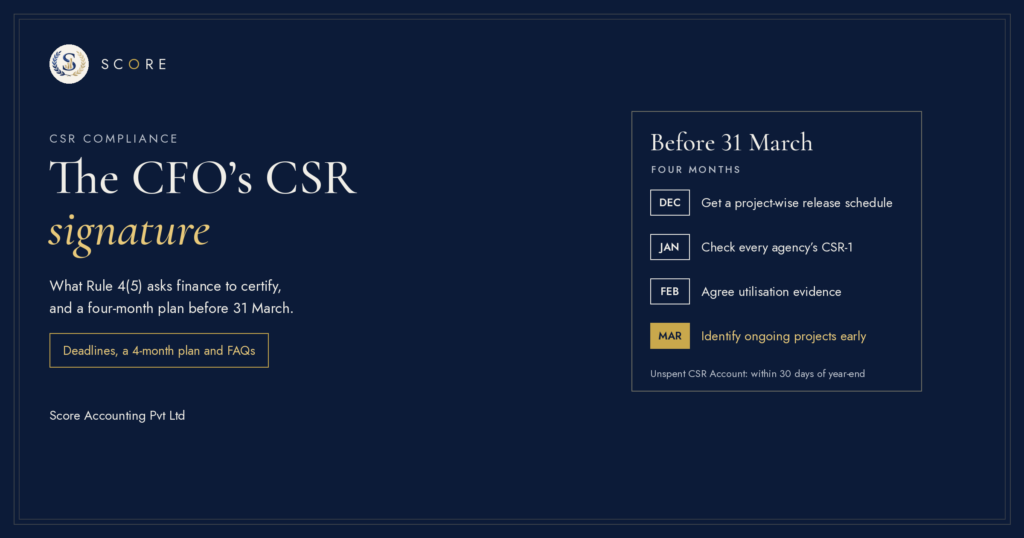
Four months are enough to turn the certificate into an informed signature. The months below give a sensible order for the work, not legal deadlines; most of these steps are worth starting now.
- December: get a project-wise release schedule. Ask your CSR team for a schedule of releases from December to March, project by project, instead of one March transfer. Staggered releases give NGOs time to spend, and give finance time to see that spending.
- January: check every implementing agency’s CSR-1 registration. Confirm on the MCA portal that each agency has a valid CSR registration number before money moves. Registration makes an agency eligible to act as an implementing agency; it does not approve any particular project, so the Board’s own approval still matters.
- February: agree on utilisation evidence. Settle with each NGO what it will send (utilisation certificates, progress reports, photographs, beneficiary data) and by when. The CFO’s certificate is only as strong as this evidence.
- March: identify ongoing projects early. Decide which projects genuinely qualify as ongoing projects, so any unspent amount on them reaches the Unspent CSR Account within 30 days of year-end. An ongoing project is a multi-year project with a timeline of up to three years, excluding the year it began.
To map projects, release dates and evidence in one place, use Score’s free CSR planning template.
By 31 March, the person who signs should be able to trace each rupee from Board approval to release to evidence of use.
Unspent CSR: two routes, two deadlines
What happens to an unspent amount depends on whether it relates to an ongoing project. Section 135 sets a different route and deadline for each (Section 135(5) to (7)).
| Unspent amount relates to | Where it goes | Deadline | What happens next |
|---|---|---|---|
| An ongoing project | Unspent CSR Account (a special account in a scheduled bank, opened for that financial year) | Within 30 days of the end of the financial year | Must be spent within three financial years of the transfer; any balance then goes to a Schedule VII fund within 30 days |
| Anything else | A fund specified in Schedule VII | Within six months of the end of the financial year | The Board’s report must also give the reasons for not spending |
Penalties under Section 135(7): a company in default is liable to a penalty of twice the amount it should have transferred, or ₹1 crore, whichever is less. Every officer in default is liable to one-tenth of the amount the company should have transferred, or ₹2 lakh, whichever is less.
This is why March matters: the classification of a project as ongoing decides which route its unspent money takes.
The year-end position, including amounts unspent and transferred, is then reported to the MCA. Our Form CSR-2 filing guide walks through that step.
FAQs for CFOs
Who signs the CSR utilisation certificate under Rule 4(5)?
The Chief Financial Officer, or the person responsible for financial management.
What does the certificate confirm?
That CSR funds disbursed were used for the purposes and in the manner approved by the Board.
Can CSR funds go to an NGO without CSR-1 registration?
Entities covered by Rule 4(1) must register through Form CSR-1 to undertake CSR activities, with effect from 1 April 2021. Projects approved before that date are not affected.
What is the deadline for the Unspent CSR Account?
Unspent amounts relating to ongoing projects must be transferred within 30 days of the end of the financial year. For FY 2026-27, that means by 30 April 2027.
What if an unspent amount is not linked to an ongoing project?
It must be transferred to a Schedule VII fund within six months of the end of the financial year, that is, by 30 September 2027 for FY 2026-27.
What is an ongoing project?
A multi-year CSR project with a timeline of up to three years, excluding the financial year in which it began.
Make it an informed signature
The CFO’s certificate is the last step of the CSR year, but it depends on decisions made months earlier: when funds are released, to whom, and on what evidence. Starting in December gives finance enough time to make each of those decisions deliberately.
CFOs and CSR heads: when does CSR first appear on your finance calendar, Q1 or Q4?
How Score can help: Score Accounting Pvt Ltd’s CSR advisory team helps companies meet their CSR compliance requirements, from planning and implementing-agency checks to year-end certification. To review your CSR plan for the rest of FY 2026-27, get in touch with Score.
Sources
- Companies (Corporate Social Responsibility Policy) Amendment Rules, 2021, Ministry of Corporate Affairs notification dated 22 January 2021: Rule 2(1)(i), Rule 4(2), Rule 4(5)
- Section 135, Companies Act, 2013, Income Tax Department, Government of India: sub-sections (1), (5), (6) and (7)
Disclaimer: This article is for general information only and does not constitute legal, financial or tax advice. Laws, rates and due dates change, and their application depends on your facts. Please consult a qualified professional before acting on it.