Surprise Audits: The Cheapest Fraud Control Most Growing Companies Skip
By the SCORE Audit & Assurance team
| Key takeaways• A surprise audit is an unannounced check of cash, stock or records. It works because the person being checked has no time to cover a gap.• Organisations that run surprise audits see about half the median fraud loss of those that don’t, yet fewer than half use them.• You need no software. Two people, a count sheet and a random date are enough.• Rotate timing and locations, count all cash at once, use blind stock counts, and investigate every variance to its root cause. |
What is a surprise audit?
A surprise audit is an unannounced verification of assets or records, usually cash, inventory or registers, carried out without prior notice to the people responsible for them. The surprise is the control: when staff know a check could happen on any day, the temptation to “borrow” from the cash box or adjust stock records falls sharply.
Surprise checks are an established audit technique in India, traditionally applied to cash, investments, stock, stores and statutory registers, especially where internal controls are weak or a company runs many branches. This guide is about using the same technique inside your own business, as a management control, not just when your auditor visits.
Why surprise audits are the best-value fraud control you’re not using
The Association of Certified Fraud Examiners’ Occupational Fraud 2026: A Report to the Nations analysed 2,402 real fraud cases across 143 countries, with a median loss of USD 104,000 per case. Three findings matter for a growing business:
• Most fraud is simple theft. Asset misappropriation (billing schemes, payroll and expense fraud, inventory theft) made up 90% of cases. That is exactly what surprise checks catch.
• Time is the multiplier. The typical scheme ran for 12 months before detection. Frauds caught within six months had a median loss of USD 40,000; those running over five years exceeded USD 1.1 million.
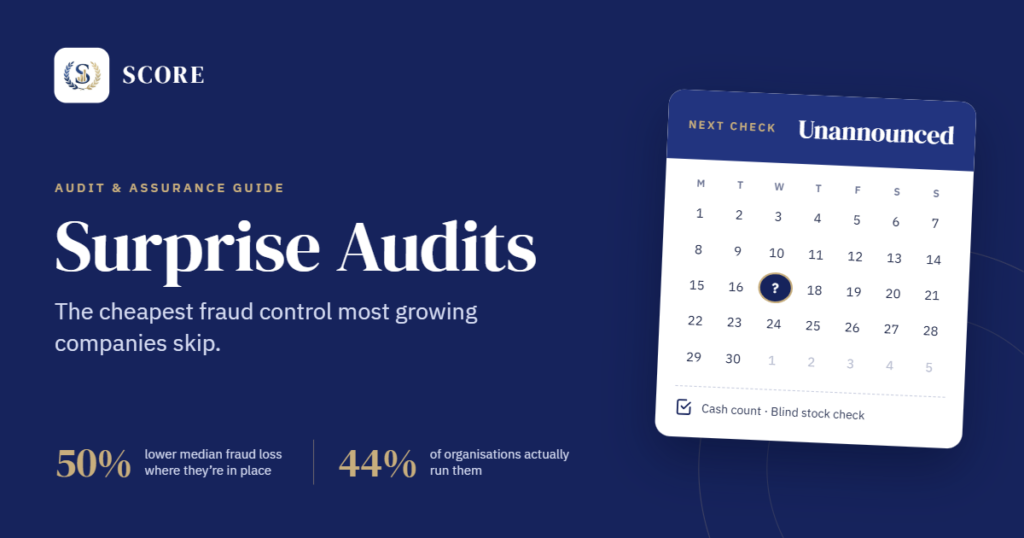
• Surprise audits work, but most companies skip them. They were in place at only 44% of organisations, yet were associated with a 50% reduction in median losses, alongside management review, proactive data monitoring, a code of conduct and job rotation among the most effective controls studied.
No other control cuts losses this much for so little cost. A surprise cash count takes two people about an hour; a focused stock check takes a few hours. Compare that with a scheme that runs undetected for a year.
| From our practiceA mid-sized logistics client had expanded quickly after Covid to eight branch offices. When we tested more than 120 controls across all locations, the critical gaps were in branch cash management: cash was being counted by the same people who handled it. Redesigning that one process was central to a framework the Board adopted within three weeks, and the next audit had zero repeat findings. |
How to conduct a surprise cash count, step by step
1. Keep it genuinely secret. Only one approver, ideally the CFO or a partner-level reviewer, should know the date and location. If branch managers are told “for coordination”, it isn’t a surprise.
2. Arrive at the start or end of a shift, when cash should reconcile most cleanly to the books.
3. Take control of all cash at once. Seal or count petty cash, the till float, undeposited receipts and cheques at the same time. If one box is counted while another sits unattended, a shortfall can simply be moved between them.
4. Count in the custodian’s presence. Both the counter and the custodian sign the count sheet. This protects honest staff as much as it exposes dishonest ones.
5. Reconcile to the books as at that moment, not to the day’s closing balance.
6. Examine every voucher, not just the total: dates, approvals, supporting bills and signatures.
7. Report within 24 hours to the approver, with any variance explained or flagged for investigation.
Red flags in a cash count
• Personal IOUs or “chits” standing in for cash
• Vouchers without approval, or dated after the last reconciliation
• Recurring round-figure expenses
• A balance that is suspiciously exact every time
• Small shortages “made good” the next day
• A custodian who never takes leave
How to conduct a surprise stock check, step by step
1. Choose where to look on the basis of risk. Prioritise high-value items, fast movers, items with high return or damage rates, and locations with recent stock adjustments. You don’t need to count everything to find the problem.
2. Impose a cut-off. Freeze stock movement at the chosen location for the duration of the count.
3. Use blind counts. Counters should not see the system quantity before counting; once they know the “right” number, they tend to find it.
4. Count, then recount variances. Any item outside tolerance is recounted by a different person.
5. Reconcile physical stock to the books, checking goods in transit, stock with third parties, and damaged or returned goods separately.
6. Investigate root causes, not just numbers. A variance is a symptom; the process that allowed it is the finding.
| From our practiceAt a fashion retail brand with a central warehouse and 30 outlets, we froze stock movement and audited the warehouse and the five highest-risk stores simultaneously overnight using barcode scanners. The root cause: damaged returns were being recorded as “sold” to hide pilferage. Shrinkage fell from 3.5% to 0.9%, and inventory accuracy reached 98%. See how we run these engagements on our Physical Verification services page. |
Red flags in a stock check
• Frequent “damaged” or “expired” write-offs concentrated in one location or shift
• Returns recorded as sales
• Negative stock balances in the system
• Adjustments posted just after month-end
• Goods “held for customers” without paperwork
• Scrap sales that never reach the books
• Variances that disappear only after a count is announced
How often should you run surprise audits?
Frequency should follow risk, and timing should be unpredictable. As a starting framework for a growing company:
| Area | Suggested frequency | Notes |
| Branch and store cash | Monthly for high-cash locations; at least quarterly elsewhere | Vary the day and week every time |
| High-value or fast-moving stock | Monthly cycle counts on a rotating sample | Blind counts; recount all variances |
| Full inventory | At least annually, plus surprise checks at key locations | Align with statutory audit timing |
| Head-office petty cash | Quarterly | Often overlooked because it is “small” |
| Fixed assets | Annual tagging and verification | Tagging creates the baseline to test against |
The most important rule: never let a pattern form. A check that always happens in the last week of the quarter is not a surprise.
Surprise audits and your compliance obligations in India
Surprise checks aren’t only a fraud control; they also generate evidence you already need.
For companies covered by the Companies (Auditor’s Report) Order, 2020 (CARO 2020), the statutory auditor must report whether management conducted physical verification of inventory at reasonable intervals, whether its coverage and procedure were appropriate, and whether discrepancies of 10% or more in the aggregate for any class of inventory were found and properly dealt with in the books. The 10% test applies class by class (raw materials, WIP, finished goods and so on), so a large shortage in one class can trigger reporting even if total inventory looks fine.
If your company has working capital limits above ₹5 crore secured on current assets, CARO also requires the auditor to report whether your quarterly stock statements to banks agree with the books. Regular surprise checks are the simplest way to make sure they do.
For multi-location businesses, our Audit & Assurance team can design a verification programme that meets these requirements. See also our industry guides for Retail & Consumer Goods and Manufacturing & Automotive.
Five mistakes that make surprise audits useless
1. Announcing them. Even “a heads-up to the branch manager” defeats the purpose.
2. Counting one cash box at a time, which lets money be shuffled between them.
3. Letting counters see system quantities before they count.
4. Treating a variance as the finding instead of asking what process allowed it.
5. Running them only after a problem appears. By then the scheme has usually been running for a year.
Frequently asked questions
What is the difference between a surprise audit and a stock audit?
A stock audit is a planned examination of inventory, often required by a lender. A surprise audit is any unannounced check of cash, stock or records, designed to catch problems before they can be hidden. A stock audit can include a surprise element, but most are scheduled.
Are surprise audits mandatory in India?
Surprise audits themselves are not mandated for most companies. However, CARO 2020 requires management to physically verify inventory at reasonable intervals, and the auditor must comment on the coverage and procedure. Surprise checks are one of the most credible ways to meet that expectation.
Who should conduct a surprise audit?
Someone independent of the assets being checked: an internal auditor, a finance team member from another location, or an external firm. The custodian should be present but must never lead the count.
How long does a surprise cash count take?
Usually under an hour for a single branch, including the reconciliation and paperwork. Stock checks on a focused sample typically take a few hours per location.
What should happen after a surprise audit finds a variance?
Recount first, then investigate the root cause, document the findings and fix the control gap. Report material variances to senior management or the Audit Committee within a day.
The bottom line
Surprise audits are cheap, fast and proven. The only thing most growing companies lack is the habit. Start with one unannounced cash count and one blind stock check this month, and download our free Inventory Management SOP for a ready-made framework.
If you’d like help designing a surprise-audit programme across your branches, talk to a SCORE partner.
This article is for general information and does not constitute professional advice. Figures are drawn from the ACFE’s Occupational Fraud 2026 report and the Companies (Auditor’s Report) Order, 2020. Last updated 24 September 2026.
Disclaimer: This article is for general information only and does not constitute legal, financial or tax advice. Laws, rates and due dates change, and their application depends on your facts. Please consult a qualified professional before acting on it.