Section 135 CSR Applicability: The ₹500 Cr, ₹1,000 Cr & ₹5 Cr Thresholds Explained
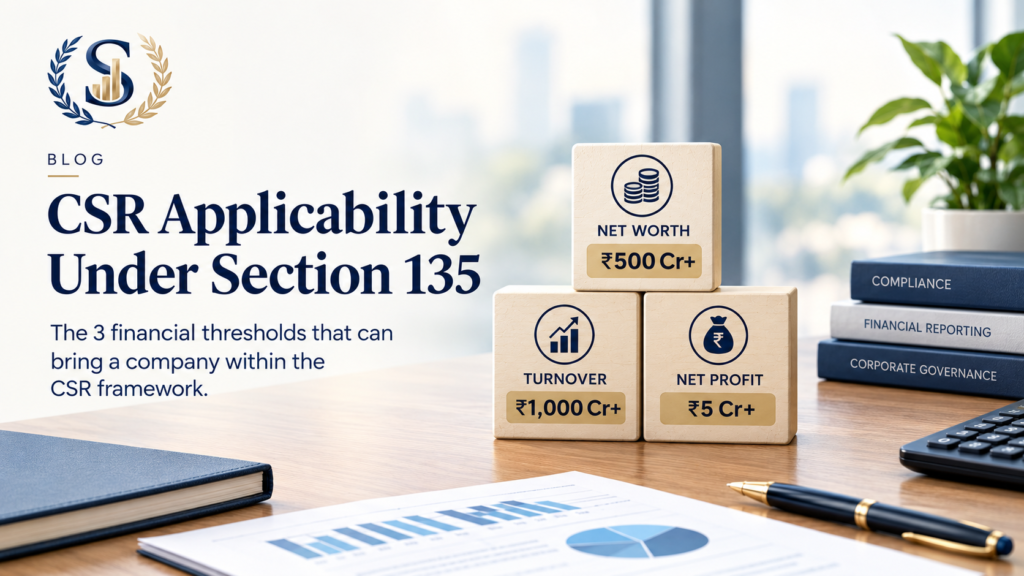
A company does not become subject to CSR because it is large, listed or profitable in the ordinary sense. Section 135 uses three specific financial tests—and crossing just one of them can bring the company within the CSR framework.
For a CFO or finance controller, the first CSR question should therefore be simple: Did the company cross any Section 135 threshold in the immediately preceding financial year?
The three CSR thresholds
Under Section 135(1) of the Companies Act, 2013, the CSR framework applies to a company having, during the immediately preceding financial year:
- Net worth of ₹500 crore or more; or
- Turnover of ₹1,000 crore or more; or
- Net profit of ₹5 crore or more.
The word “or” is important. A company does not have to cross all three thresholds. Meeting any one of them is enough to trigger the statutory framework.
That makes CSR applicability different from a simple “large company” test.
Proposed change: the net profit threshold may rise to ₹10 crore
The Corporate Laws (Amendment) Bill, 2026 was introduced in the Lok Sabha on 23 March 2026 and proposes changes to Section 135. As of 20 November 2026, the Bill has not been passed, so the three thresholds above remain the law today.
For CSR, the Bill as introduced proposes to:
- Raise the net profit trigger from ₹5 crore to ₹10 crore (or another sum the government prescribes). The net worth (₹500 crore) and turnover (₹1,000 crore) tests stay as they are.
- Let companies whose CSR obligation is up to ₹1 crore work without a CSR committee (the current limit is ₹50 lakh).
- Give companies 90 days instead of 30 after the financial year ends to move unspent money for ongoing projects into the Unspent CSR Account.
- Allow the government to exempt certain classes of companies that meet prescribed conditions.
The Joint Parliamentary Committee that examined the Bill presented its report on 3 August 2026. It recommended removing the government’s power to change the threshold later, observed that the class-wise exemption lacks guidance in the law, and suggested a notified list of entities whose contributions should not count as CSR spending.
What this means for your company today
Keep planning CSR on the current law. If the Bill passes, the companies most affected are those covered only because of the net profit test, with net profit between ₹5 crore and ₹10 crore and net worth and turnover below the other two limits. A company covered by net worth or turnover stays covered either way. Any change will apply only from the date the government notifies after the Bill becomes law.
For a fuller breakdown of the committee report, see Corporate Laws (Amendment) Bill, 2026: JPC Report Highlights, Status & What Changes for CSR. Sources: PRS Legislative Research bill tracker and PRS summary of the JPC report.
Which year’s numbers matter?
The threshold is tested with reference to the immediately preceding financial year.
This means finance teams should not wait until the current year’s CSR budget is being finalised. The applicability assessment should be built into the annual closing and compliance calendar.
A useful internal control is to maintain a threshold dashboard containing:
Net worth | Turnover | Net profit | Applicable threshold | CSR applicability
That creates a documented basis for the conclusion reached.
Does crossing a threshold automatically mean a 2% payment?
Not exactly.
First comes applicability.
Then comes the CSR obligation calculation.
For a company covered by Section 135, the Board must ensure that the company spends at least 2% of the average net profits made during the three immediately preceding financial years, calculated in accordance with Section 135 and the applicable rules.
Therefore, the ₹500 crore, ₹1,000 crore and ₹5 crore figures are applicability thresholds, not the amount on which the 2% is calculated.
That distinction is frequently lost in simplified CSR explanations.
What should finance teams check?
A practical applicability review should cover five questions:
1. Did the company cross any threshold?
Check the preceding financial year’s net worth, turnover and net profit.
2. Is the calculation based on the prescribed methodology?
Net profit for CSR purposes is not necessarily identical to the headline profit figure appearing in management reporting. Section 135 contains a specific explanation regarding the calculation of net profit.
3. What is the resulting CSR obligation?
Calculate the prescribed 2% amount using the average of the preceding three financial years, where applicable.
4. Is there any unspent amount from an ongoing project?
If the company has an amount in its Unspent CSR Account, additional governance requirements can arise, including the requirement to constitute a CSR Committee under the amended CSR Rules.
5. Has the conclusion been documented?
The applicability calculation should be capable of being reproduced during statutory review, Board review or internal audit.
Why this matters
CSR compliance is often approached as a year-end activity. That is risky.
A company can cross a threshold because of a change in turnover, a significant profit year or another movement in its financial position. If the applicability review happens only after accounts are finalised, management may already have lost valuable time for project planning, Board approvals and implementation.
The better approach is to make CSR applicability a recurring financial-control checkpoint.
Bottom line
The Section 135 test is straightforward:
₹500 crore net worth OR ₹1,000 crore turnover OR ₹5 crore net profit in the immediately preceding financial year.
But the compliance decision should not stop there.
Once applicability is established, management needs to move immediately to the next questions: How much is the obligation? What qualifies as CSR? Who approves it? How will it be monitored? And what happens if the amount remains unspent?
That is where CSR moves from a threshold calculation to a governance responsibility.
Related service: Score Accounting Pvt Ltd offers CSR compliance and advisory services for companies covered under Section 135 of the Companies Act, 2013.
Disclaimer: This article is for general information only and does not constitute legal, financial or tax advice. Laws, rates and due dates change, and their application depends on your facts. Please consult a qualified professional before acting on it.