CSR and Local Governance: Where Accountability Still Breaks Down
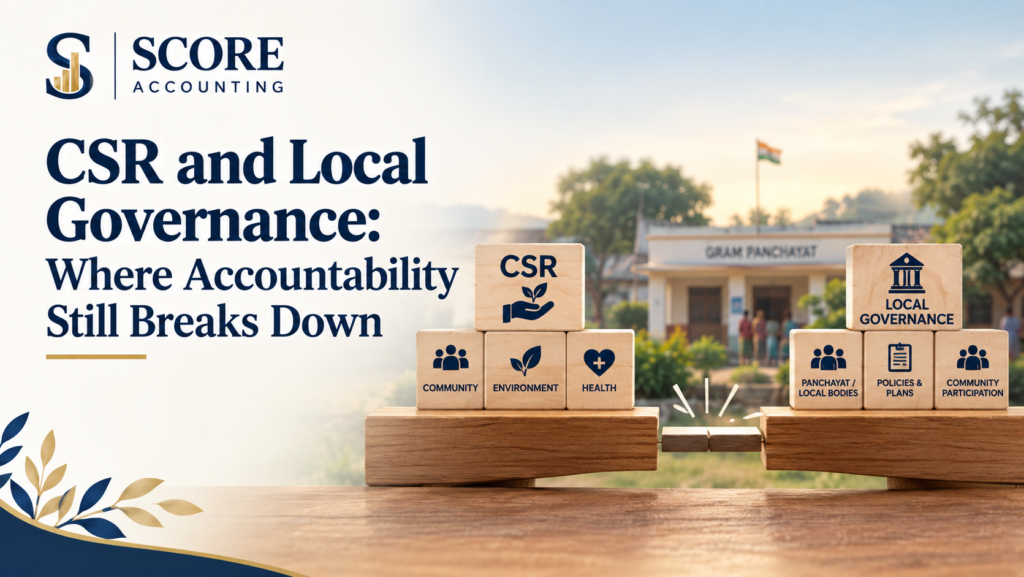
CSR can fund a school, health programme, sanitation initiative or community asset. But funding an activity does not automatically create accountability for the outcome.
CSR is not a substitute for government
Section 135 creates a corporate responsibility to undertake eligible CSR activities. It does not transfer statutory functions of local government to companies.
Yet CSR projects often operate where local bodies, community organisations, companies and public institutions influence the same outcomes. Without defined roles, accountability can become blurred.
Where gaps appear
A project may have strong expenditure records but weak outcome measurement; an implementing agency but no beneficiary feedback mechanism; Board approval but little local coordination; or infrastructure spending without a maintenance plan.
In each case, money may be traceable while impact remains uncertain.
What better governance looks like
Before implementation, identify who owns the intervention, who operates it after funding ends, who measures outcomes, who handles grievances and who verifies utilisation.
A mature CSR control chain is:
allocation → utilisation → output → outcome → sustainability.
The finance perspective
Finance leaders naturally focus on whether money was spent for the approved purpose. That is necessary, but it is only one layer of accountability. Boards can also ask whether the project is producing the intended result and whether continuing funding remains justified.
Key compliance implication
CSR can complement local governance, but it should not become an accountability substitute for it. Strong projects define responsibilities across the company, implementing partner, community and public institutions before funds are released.
The accountability problem is structural
CSR projects often operate at the boundary between corporate funding and public-service delivery. A company may finance a health camp, sanitation asset or education intervention while local authorities retain responsibility for public infrastructure and service continuity. If the project file does not distinguish these roles, an intervention can become dependent on a corporate sponsor without a clear owner after the CSR funding cycle ends.
Expenditure accountability is not outcome accountability
A finance team can establish that ₹50 lakh was transferred, invoices were received and the implementing agency submitted utilisation evidence. That does not by itself establish whether the intended beneficiaries were reached. Management therefore benefits from separating three questions: Was the money used correctly? Was the activity delivered? Did the activity create the intended outcome?
Design for handover
Projects involving assets or recurring services should identify who will maintain the intervention after the CSR period. The project agreement can address ownership, maintenance, community participation, escalation and reporting. This is particularly important where a company funds infrastructure that requires public or community stewardship after completion.
Use local feedback as a control
Community consultation and grievance channels can reveal problems that financial reports do not capture: inaccessible facilities, beneficiary exclusion, poor service quality or delayed implementation. Feedback should not replace financial controls, but it can complement them.
Where this leaves companies
CSR can complement local governance without becoming a substitute for it. The practical objective is to make responsibility visible: company, implementing partner, community and public institution should each have a defined role, with evidence of performance and a plan for sustainability.
Editorial verification note
Primary: Companies Act, 2013, Section 135/Schedule VII and Companies (CSR Policy) Rules, 2014. Secondary: current MCA guidance/notifications. Recheck amendments and filing instructions immediately before publication.
A governance dashboard helps
For community-facing projects, management can track five indicators: financial utilisation, physical progress, beneficiary reach, outcome progress and post-project ownership. Reporting these together prevents a project from being marked green merely because invoices have been received. It also gives the Board a clearer basis for deciding whether to continue, modify or close a project.
A practical management lens
Local governance projects also benefit from an explicit theory of change. State the problem, intervention, immediate output, expected outcome and long-term dependency. Then identify which part the company controls and which part depends on public institutions or community actors. This prevents the company from claiming responsibility for outcomes it cannot control and helps management distinguish implementation risk from broader ecosystem risk. A credible CSR report can acknowledge both rather than overstating impact.
Final review point
For projects involving government departments, written coordination can also reduce ambiguity. Record which organisation is responsible for approvals, infrastructure, operations, maintenance and community engagement. The company should then report its own contribution without implying that it controls every downstream outcome. This produces a more credible account of CSR impact.
Disclaimer: This article is for general information only and does not constitute legal, financial or tax advice. Laws, rates and due dates change, and their application depends on your facts. Please consult a qualified professional before acting on it.